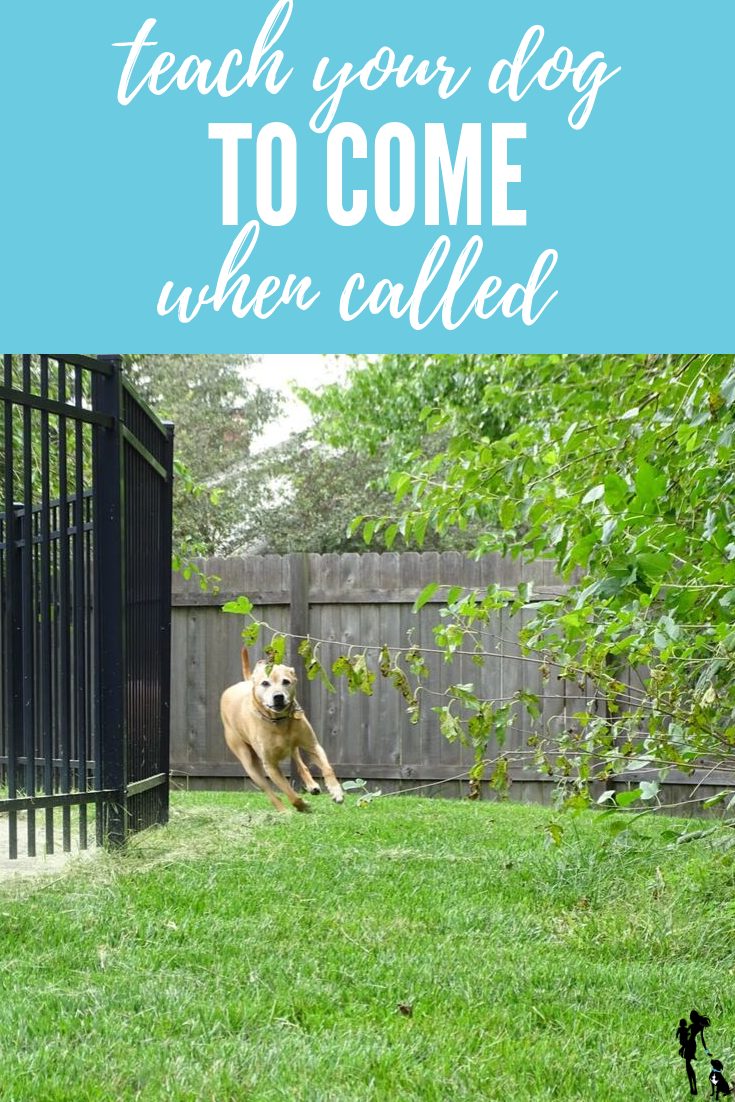
A few weeks ago, I posted an Instagram Story of us working with Cooper in the backyard. We were doing recall training–that is, working on getting him to come when called–and making a super fun game of it. It’s one of his most favorite games, actually, so he’s gotten good at it over the years.
That story elicited a ton of DMs asking how we taught him the game, what we did to teach Coop his recall, and so on. So, I decided to pull my tips together in one past in case it helps anyone else who’s trying to teach your dog recall OR who’s struggling to troubleshoot a problem with your dog’s recall.
OhMyDogBlog.com is a participant in the Amazon Services LLC Associates Program, an affiliate advertising program designed to provide a means for sites to earn advertising fees by advertising and linking to amazon.com.
How to Train Your Dog to Come
OK, let’s get super basic here: Teaching your dog to come when called is the most important thing he or she needs to learn for safety. If you’ve tried to teach recall and it didn’t stick, or if your dog knew it once and now doesn’t, or if you’re starting this out for the very first time, the process is the same.
First, pick a cue. Now, if you’re in the “didn’t stick” or “now doesn’t” camp, you need a word other than what you used previously. That word–probably “come”–is now dead to you. Pick something new. I’m a big, big fan of a specific whistle, but it doesn’t matter. Start by choosing your cue. For the sake of this post, I’m going to use “come,” but it can be anything short.
Next, watch your language! Don’t use that cue word for anything other than recall and never for anything negative. So, let’s say your dog is playing in the backyard and it’s time for his bath. Don’t call “Cooper, come!” and then drag him into the tub. From the moment you decide to train your dog to come, the recall word you chose can only be used for good things.
Third, set the bar really low. Start training recall in a distraction-free zone. Take your dog out to go to the bathroom first, then go somewhere quiet and comfortable like your living room. Get a friend or family member to help, and sit a few feet away from each other. Call your dog to come to you, dole out a valuable treat (this is NOT the time for dry, crunchy cookies, y’all), then have your friend do the same. Give lots of love and praise while you practice. With the bar still set low, move the game somewhere slightly more distracting–say, the backyard. Practice, practice, practice.
Don’t forget that distance is a degree of variability you need to practice, too. If you and your buddy stand 10 feet apart in the backyard, standing 15 feet apart is a nice, slight raise of that training bar.
Here’s something that works well to raise the bar ever so slightly: Once your dog masters the cue in the living room and the backyard, keep practicing with your friend as you increase the difficulty AND simultaneously you start working with your dog one-on-one back in the quiet/comfy spot. Let’s say you and your friend are working 10 feet apart in the backyard. That’s awesome! The next day, your friend isn’t available. So, you head into the living room with your treats and periodically call your dog to come and reward. Consider those activities two distinct parts of the training–your dog needs to reliably come to you when it’s you alone, but that’s much more difficult to manage in the early stages. So, work on both! But, again, keep the bar really super low so that you set your dog up to win.
Now, eventually your home and your backyard will become too easy, and you’ll have to raise the bar again to, say, your front yard. Unless your front yard is fenced in, you NEED to put your dog on a long line. (This is the one we use.) You are in training here, so it’s NOT the time to test your dog’s reliability.
Finally, keep at it. Training your dog to come when called is nothing like training your dog to sit in the sense that you need to work on recall all the time to reinforce it and to proof it, while a behavior like “sit” is naturally well integrated into your day and the stakes are low. Recall training should be ongoing. The cue should always stay positive, and you should practice every chance you get so that when you do find yourself needing it, your dog’s already an ace.
A Quick Aside About Training Treats
Get the good ones.
Seriously, this isn’t biscuit time. This is freeze-dried liver time. This is squeeze cheese time. This is shredded chicken, turkey bacon, warmed-up hot dog time. Whatever is your dog’s go-to, can’t-resist, must-have treat, recall training is the time to use it. You don’t want your dog to think, “Eh, why bother? She just has that crappy dry cookie, and here I can eat rabbit poop,” or whatever it is. You know your dog’s preferences and tolerances, so pick the tippy-top of what he or she likes the best.
Make Recall FUN!
What I shared on Instagram is a game we call “Recall Relay.” John stands at one end of the yard, and I stand at the other. We both have a pile of treats, and we just call Coop back and forth. He loves it because he loves treats, he loves running, and he loves playing with us. It’s a win all around!
We modify the game outside and inside, too, by adding in a hike-and-seek component. I’ll duck behind a shrub or behind the sofa and call Coop to come. He LOVES seeking us out, and finding us is almost as much of a reward to him as the actual treat we dole out.
Sometimes I’ll see him out in the yard doing nothing special, and I’ll grab a treat from his jar and call him to come–just for the fun of it and just for the reinforcement.
When can I stop using treats? And other troubleshooting tips…
“Ugh, my dog will only come because he knows I have treats.”
So?
I mean, truly, I only do my work because I know I’ll get paid. I’m not going to submit a bunch of copy to a client who might or might not compensate me… There’s nothing wrong with a rewards system, especially for a behavior as important as come.
“My dog was so good at this, and now he ignores me.”
OK, so you’ve poisoned the cue. What that means is you’ve used “come” one too many times without payment or followed by something unpleasant or maybe it wasn’t as good as you thought it was to begin with. The reason doesn’t actually matter, and the fix is (sorta) simple: Pick a new cue and start over. It’s far easier to train it as if it were a new behavior with a new cue word or whistle than it is to troubleshoot what went wrong with your old cue.
“He will come when called at home, but at the park… nada.”
You moved the bar too high too fast. Your dog needs to go back to recall boot camp with some purposeful retraining.
Also, know that a recall will never, ever be 100 percent. Let’s say you DO have it down pat at the park. Then, one day, there’s a deer standing in the middle of the field, and your dog has never seen a deer before, and your dog decides he reallllllllllyyyyy needs to chase that animal… or, let’s say a stray cat darts across the street directly in front of you, and there’s nothing your dog loves more than chasing a stray cat… or, the ice cream truck hits a pothole and the whole giant tub of ice cream bounces out the back and splats on the sidewalk… or, whatever your dog finds truly irresistible. You can practice and proof and make it a game, and your dog might still ignore you in the face of something too good to be true.
It’s another topic for another post, but it’s one of the many reasons I strongly advocate for keeping your dog on leash at all times unless you’re in a fenced-in yard or dog park. Recall, imo, is an emergencies-only cue, but the training is a fun, all-the-time thing.
Teaching Your Dog to Come When Called Is Worth the Effort
You might be thinking that this sounds like a lot of effort. You might be thinking that this sounds like it takes an enormous amount of time.
You’re right. It is a lot of effort, and it does take a lot of time.
But it’s so worth it.
Twice in Cooper’s life, unforeseen circumstances resulted in him getting loose. The first time, our gate broke–unbeknownst to us–and the second time was immediately after we moved to Louisiana. We took the dogs outside with no clue that Coop could just waltz right under the elevated house from the fenced-in front yard to the un-fenced-in front yard.
In both cases, thank goodness, he came when I called.
We practice. We make it fun. And, when we need it, it works.
So, there you have it: My tips for how to teach your dog to come when called. Have you taught your dog a recall? How does he or she do? Have you encountered a need to use it? How do you proof the behavior? Please share in the comments so we can all learn from each other!
Agreed, this is the single most important this you can teach your dog. I have a beagle, and I’m tired of hearing that a beagle has no recall. Mine does. I trained him. Just like I trained him to do agility.Apparantly I’m just really lucky – insert eyeroll here – No, I’m not lucky, I’m persistent and I give good treats, I don’t expect my dog to work for free. It’s not rocket science people. Keep it simple. Start small. Build slowly.
The other really important training is to wait at a door or gate. No one wants a dog to rush through an open door and straight out onto the road. Do it just like recall, but with a ‘wait’ cue.
Thanks…this is a post I definitely needed. Apparently come at my house is no longer a valid cue, I have no idea how I burned this out, but I will be picking a new word and going back to basics. Thanks for the info!
This is one of the most important things to teach your dog. I had a precious dog as a teenager and taught her this so well she never left my side, and came to the sound of her name, every single time. Emily, our current girl, is beginning to catch on. I need to get more serious about it, again, but I shudder to think of all the dogs that don’t come when called and end up in dire circumstances. This is a must for all dog people. It should be taught at shelters.
Great article,
I can see the importance to make my dog knows a recall command. There has been so many times where I have my two dogs with me and they see people walking by themselves or with dogs, and all of a sudden they ran and not listen to my command..Luckily, there hasn’t been a bad situation that came out as a result of this. What you saying is what I am learning on my dog training session that I started just his week. Great work, keep up the good work.